
|
|
|||||||||
|
Interested in Baroque interpretation for harpsichord and other keyboards? Find most problems resolved in the comprehensive recent book: PLAYING THE BAROQUE HARPSICHORD |
Also Interested in early keyboard fingerings? The most complete handbook ever is now available: BAROQUE KEYBOARD FINGERINGS |
|
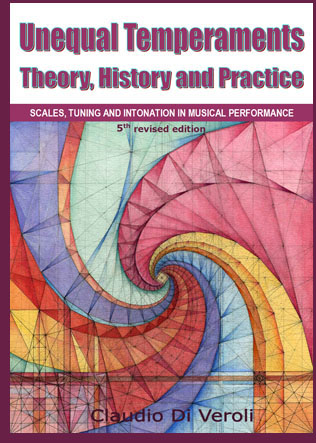
Unequal Temperaments, 2nd Edition: 456 pages and 335 figures incorporating decades of new findings in the field.
PART ONE provides the acoustical background. The main temperaments are then covered, with a thorough analysis of their musical features. Finally a HISTORICAL SURVEY guides the performer in the selection of temperament(s) for his/her repertoire.
PART TWO consists of keyboard tuning and fretting instructions for several temperaments, plus unequal temperament directions for unfretted strings, voices, woodwinds and brass wind instruments, including variable intonation techniques.
PART THREE covers multiple divisions of the octave and the analysis of historical sources, including some research results published here for the first time.
You are welcome to read below published Reviews and a Preview. Please click on the button below for price details and to buy the book.
If you have already bought the book and wish to re-download it, click here for directions.
PART ONE - DESCRIPTION, ANALYSIS, HISTORY
> Accurate calculations based on specially developed spreadsheets, available to the reader as a free download.
> A definitive and extensive treatment of Baroque French irregular temperaments, their evolution in theory and practice (30 pages).
> A new comprehensive analysis of the temperaments advocated for J.S. Bach in modern times,
plus exhaustive computer-aided searches for Bach's temperament, with significant new results (19 pages).
> A much expanded Historical Review, with 33 sections and subsections covering all the musical periods
in Western musical history, including differences between instruments and countries (30 pages).
> A full treatment of Equal Temperament, its diffusion through the Western world and evolution of tuning accuracy (12 pages).
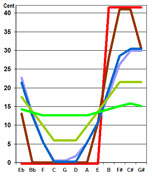
> Full graphical comparisons between and within groups of temperaments.
> Simple, accurate and fast keyboard-tuning schemes for each temperament: early-style tuning directions are included.
> Fretting charts for an ample assortment of temperaments and open-string tunings.
> Charts and directions for unequal temperaments in early woodwinds.
> The most complete ever treatment of unequal temperaments for natural brass instruments.
> Extras downloadable from this website: Sound Examples, Spreadsheets and other Goodies.
Why an eBook?
This book can be read on the screen of a PC, Mac and any desktop or portable device capable of showing documents in Adobe Acrobat v.6.0 format or later. It is also formatted for impeccable printing on Letter paper, A4 or A5 (two pages in an A4 sheet). Benefits of buying an eBook compared to a ready-printed volume:
PRICE: less than 1/5th of the estimated price of a printed volume.
AVAILABILITY: an eBook is never out of print.
SECURITY: the reader can make a backup copy, so that the eBook cannot be lost or stolen.
PRINTING: if a printed volume is really needed, the reader can print it from any home computer.
MANY FIGURES: more than 330 figures, most of them full-colour photos and charts.
COLOUR: colour is freely used in the text and tables, helping to easily understand complex matters and relationships
PORTABILITY: the reader can carry the book around in a laptop computer or other portable device.
INTERNAL LINKS: internal hyperlinks allow the reader "jumping" to other parts of the eBook and "jumping back" as well..
WEB ADDRESSES: they allow accessing directly web pages referred to.
REFERENCE: the reader interested in a particular topic can quickly search and find all the references to it in the eBook.
TIMELINESS: you buy the eBook and download it immediately.
Accordingly, there are no plans to make this book available in printed form. This new book is a 17Mb document file. It downloads in just 2 to 4 minutes using an Internet broadband service. .
David Hitchin in The British Clavichord Society newsletter, No.45, Oct.2009:
"Claudio Di Veroli's work has the advantage (or disadvantage) of being at least twice the size of those by his competitors.
In the eleven chapters of the first part Di Veroli introduces musical intervals, the Pythagorean scale, equal temperament, just intonations, meantone, ... lute temperaments, irregular French and irregular 'good' temperaments, comparative evaluations and a review of historic performance. He defines a series of seventeen principles ... [T]hey provide a solid framework for understanding and comparing temperaments. The author occasionally uses measures likely to be known only to those with an advanced statistical training (he was a student of Sir David Cox, one of the most eminent British statisticians). As a statistician myself, I can confirm that his choice of methods is appropriate ...
The second part is about tuning and fretting instructions ... There is advice about hearing and using beats, thirty hints and tricks for harpsichord tuning, transposing instruments ... a list of schemes for keyboard instruments, fretting instructions for lutes and viols, intonation for violins and voices, woodwinds and brass instruments.
The third part ... includ[es] multiple divisions ... and an analysis of much of the historic documentation for temperaments.
The book contains some original research. Di Veroli concludes that Barnes' temperament is the optimum one for the Well-Tempered Clavier ... Di Veroli generated and evaluated the nearly 17 million possibilities, and found that very slight improvements were possible, but they were so small, and made tuning so much more difficult, that they were not worth using in preference to Barnes.
... many pages make good use of colour ... Di Veroli ... includes links to audio files, and surely there is nothing more self-evident than the need to hear different temperaments as one reads about them ... There are also two useful spreadsheets. ... This work is only available as ... a .pdf file ... I printed it out. It is formatted for convenient printing on A4 paper, but it was quite legible when reduced to A5 ... it then became a pleasure to read ... the explanations are clear and easy to follow. He has taken on a Herculean task of reviewing and explaining the history and application of unequal temperaments, and while it is unlikely that all experts in the subject will agree with him on all points, he presents convincing arguments and detailed documentation. ... This is one of the most interesting books that I have read for a long time."
Bradley Lehman in The Viola da Gamba Society Journal, Volume 3, Part 2, Dec.2009:
Please click here for details about this unusual review and a published rebuttal.
Pedro Persone in Early Music America, Spring 2010, Mar.2010:
"This e-book, published in March 2009, is now available on-line at ... Di Verolis study is divided into three main parts. Part I consists of Description, Analysis and History (11 chapters in total). The seven chapters of Part II explain Tuning and Fretting Instructions. Part III consists of Complementary Topics (four chapters and five appendices). Di Veroli´s book is a relevant complementary source to the existing bibliography on the important subject of temperament and can be counted among the best-known books in the field. ...
...it is ... necessary to temper our instruments ... the difference ... is the "dust" we have to sweep under the rug. Di Veroli provides us with the recipes on how to distribute our "dust" by using the historical unequal temperaments. He does this by means of symbols, ratios and formulas, and explanations ... The most important temperaments are explained in this book ...
In addition, Di Veroli ... offers important tips about the way to manage tuning hammers or how to change a keyboard temperament shortly before a public performance. The huge number of known temperaments are explained step by step, and fretted clavichords are given a separate chapter. The e-book also offers information about plucked fretted instruments and the intonation of woodwind and brass instruments.
I am very happy to recommend this book, since it will provide pleasant and useful reading for both students and enthusiasts."
Readers' comments: The author has received many personal comments from readers, unanimously happy with the book's structure, coverage, presentation and cost.
|
With our relatively simple yet powerful "dissection tools" we are now ready to enter, in the following Chapters, the fascinating world of early temperaments in Renaissance, Baroque and Classical times. In meantone temperament Contrary to an often repeated but wrong belief, the main restriction to modulations is not caused by the wolf fifth but instead by the 4 wolf major thirds, or rather ...
The fascinating properties and proportions of the Standard meantone diatonic and chromatic scales are treated in the following ... Let us now see how ancient musicians fared in practice when asked to produce a Spiral of Fifths with up to 5 pairs of flats and sharps ... : Voices, unfretted strings, trombones and trombe da tirarsi ... Other brass wind instruments ... Fretted strings ...Woodwinds ... Keyboards ...
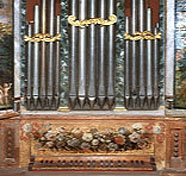
Good temperaments ... Some modern writers have imposed the custom of calling them 'Well temperaments'. This is almost a malapropism and unnecessarily violates basic language rules . Clearly therefore Chaumont and F.Couperin were using different variants ... The reconstructed Couperin organ temperament is shown below ...
A disproportionate amount of effort and ink has been dedicated [by modern writers] to the analysis of the multiple variants of circular temperaments proposed by German Baroque theoreticians. ... We will eventually find that only a handful is really worth studying and tuning to ... If the reader still finds it difficult to grasp which flavour of 'Good' temperament J.S.Bach advocated or preferred, he/she is in good company ...
Bach did not write the WTC in order to advocate a peculiar tuning to be discovered by archaeologists of the future trying to decipher 'Rosetta stones' ... A full classification of the time (Artusi 1603) had the instruments divided into three families according to their temperament However as we come into Baroque times, fretted instruments are found increasingly playing together with keyboards
The Baroque is the only period in Western musical history in which the different amount of temperament of the intervals around the Circle of Fifths eventually becomes a component of musical expression. Unequal temperaments were still feasible and practised. But Equal Temperament was now gaining considerable momentum. What was the most common situation in so called Classical times? What were most musicians doing after 1750?...
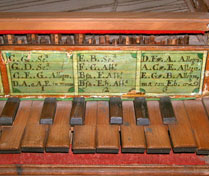
THIRTY(30) HINTS AND TRICKS FOR HARPSICHORD TUNING. [For] early stringed keyboards the following guidelines are an integrated set of suggestions and instructions in a working-practice sequence. ... Meantone Fretting Unlike the pure intonations where some considerable mistuning was expected by early audiences and anyway unavoidable in meantone a precise tuning is both feasible and expected. A simple [fretting] procedure follows
Standard French ordinaire being the most unequal circular temperament, the conclusion back in 1978 was that a most accurate fretting was possible for all the remaining circular temperaments as well. This has now been confirmed This Chapter is intended to show how to play easily and accuratelyunfretted instruments in unequal temperaments. This is achieved by using specific fingering charts and techniques. ... The text has been written so as to be most useful to singers as well.
The road to intonation hell is paved with just-intonation intentions. ... Were Bach's horn and trumpet players (e.g. the famous Reiche) better than Handel's (e.g. the famous Snow)? ... were perhaps Bach's players using narrow-bore instruments that would play softer but with increased flexibility and ease in the upper parts of the register? |
The Unequal Temperaments: Theory, History and Practice eBook is a self-contained work. No additional files are needed to read it, understand it, enjoy it and/or put the advice into practice. Once you have purchased the book, however, additional goodies are waiting for you to enhance your experience: a set of Sound examples, an updated Errata sheet, custom-designed Icons and the latest version of the Unequal Temperament Spreadsheets. You can access them all from the Unequal Temperament Goodies webpage.
We have now added a separate webpage Unequal Temperament Links, listing links to other sites with contents we find interesting and useful.
This site owes a lot to the encouragement and helpful suggestions from David Bauguess,
musician and piano tuner in Colorado, USA.
Web site designed and maintained by Seattle PC Service ®, Bray, Ireland
Page last updated:
27-Jan-2013